
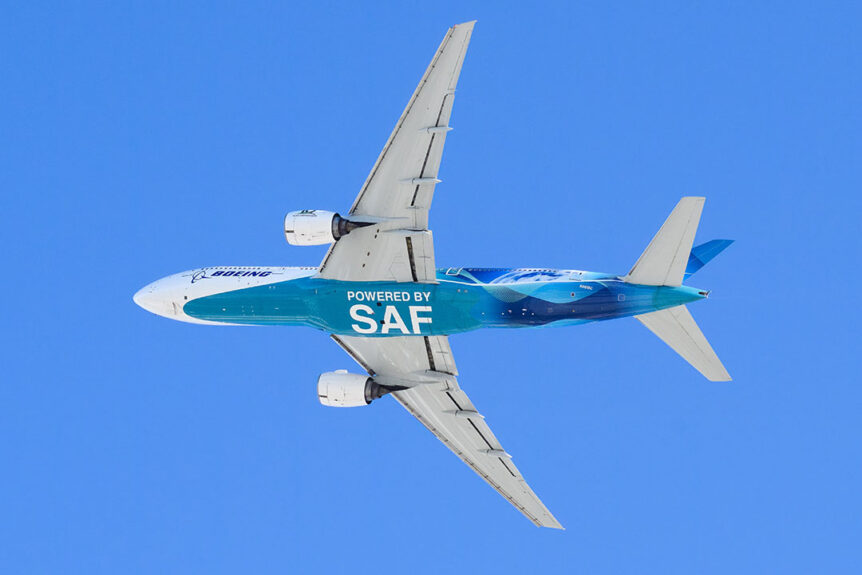
Sustainable Aviation Fuel (SAF) is a certified drop in jet fuel produced from renewable or waste derived feedstocks, qualified under aviation standards such as ASTM D7566 for synthetic jet fuel and used in blends that also meet ASTM D1655 specifications for Jet A and Jet A 1. SAF can be blended up to approved limits and handled in existing infrastructure, which preserves safety while avoiding parallel storage and distribution systems.
What is Sustainable Aviation Fuel

Technician is refueling aircraft with Sustainable Aviation Fuel (SAF)
Sustainable Aviation Fuel (SAF) is chemically similar to conventional kerosene but produced from pathways like HEFA, ATJ, FT, alcohol to jet, and emerging power to liquid routes that synthesize hydrocarbons from captured carbon and green hydrogen.
ICAO’s lifecycle framework provides methods to quantify emissions for each batch so that operators can claim reductions under market based programs such as CORSIA.
How Sustainable Aviation Fuel Improves Aviation
- Lower lifecycle emissions Many approved SAF pathways deliver substantial lifecycle greenhouse gas reductions versus fossil jet, with the exact value determined by feedstock, process energy, and logistics verified under recognized lifecycle models.
- Drop in compatibility Sustainable Aviation Fuel (SAF) meets drop in criteria so airlines can use blends without engine modifications or new fueling systems. T
- Near term scalability lever While aircraft and air traffic improvements matter, Sustainable Aviation Fuel (SAF) is a primary lever on the path to net zero because it fits the current fleet and airport network.
How Widely Sustainable Aviation Fuel Is Being Adopted

Emirates Airlines A380 jet engine with SAF. | Photo: Photofex_AUT / Shutterstock.com
Volumes are growing yet still a small share of global jet demand. IATA estimated that 2024 output reached about 1.1 million tons, roughly 0.3 percent of jet fuel, as some new facilities slipped schedules into 2025.
Regional dynamics are shifting too. Asia is expanding production capacity with projects in Singapore, Thailand, and Malaysia and could become a net exporter as demand mandates lag.
Regulations and Implementation

Refueling Ground service before flight.
Technical standards and certification
Use in commercial service requires compliance with aviation fuel standards. Sustainable Aviation Fuel (SAF) meets ASTM D7566 for neat synthetic components, is blended within the approved limit, then released as a certified jet fuel under ASTM D1655. This preserves engine airworthiness and supports airport interoperability.
CORSIA and sustainability criteria
To qualify as a CORSIA eligible fuel, Sustainable Aviation Fuel (SAF) must meet sustainability criteria covering lifecycle emissions, land use, biodiversity, and social safeguards. ICAO publishes detailed criteria and verification requirements, including methane management and supply chain certification.
European Union mandates
The EU’s ReFuelEU Aviation regulation establishes binding minimum shares of Sustainable Aviation Fuel (SAF) in fuel uplifted at EU airports starting at 2 percent in 2025 and rising on a schedule toward 70 percent by 2050, with a specific sub mandate for synthetic e fuels.
United States incentives
The Inflation Reduction Act created a production tax credit for Sustainable Aviation Fuel (SAF) that meets a minimum 50 percent lifecycle reduction relative to petroleum jet. Treasury and IRS guidance set the credit at 1.25 to 1.75 dollars per gallon based on verified reductions and allow use of the 40BSAF GREET model to calculate eligibility.
Practical Implementation for Airlines and Airports

Technician refueling private jet with SAF at the airport.
- Supply contracting and certificates Airlines start with small blends through airport supply or book and claim models that match physical Sustainable Aviation Fuel (SAF) delivered into the system with environmental attributes used by the purchaser. Lifecycle values are tracked to claim reductions under CORSIA through ICAO’s methodology.
- Blending and quality control Producers manufacture neat fuel to ASTM D7566, blend within the approved limit, then recertify the blend to ASTM D1655 before it enters hydrant and tanker systems.
- Cost and scale Market prices remain above conventional jet due to feedstock constraints and early stage capital costs. Policy support in the EU through mandates and in the US through credits aims to narrow the gap while catalyzing new capacity.
What to Watch Next

Honda Motor’s aircraft unit has achieved a new milestone in aviation e-mobility by designing one of its models to successfully fly on 100% sustainable aviation fuel (SAF). | Photo: hondajet.com
Expect higher Sustainable Aviation Fuel (SAF) blending at major hubs subject to mandates, rapid development of e fuel plants aligned with the synthetic sub mandate in Europe, and potential price signals from Asia as capacity grows faster than regional uptake.
Production forecasts for 2025 and the scale of facilities coming online will shape availability.