
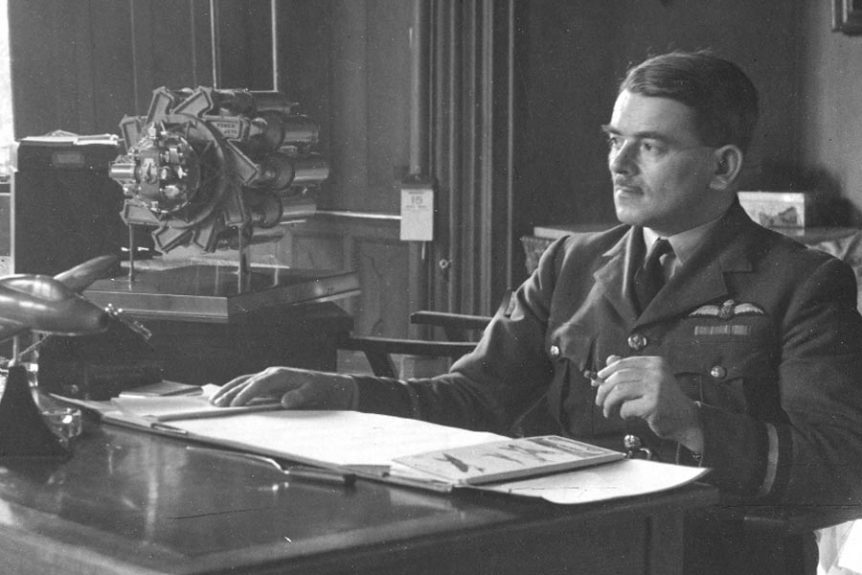
Frank Whittle: The Jet Engine Pioneer Who Revolutionized Modern Travel
Frank Whittle, an English inventor and British Royal Air Force officer, created a groundbreaking invention 90 years ago that continues to shape modern aviation. Today, jet engines and aircraft are constantly evolving, and with the rise of private travel among the wealthy—often showcased on social media—it’s no surprise that private jet travel has become a timeless luxury.
Yet, during Whittle’s era, the primary focus of jet aircraft was their potential use in global war efforts during WWII. Although jet propulsion had been theorized in various forms before Whittle’s 1928 patent submission, no one had successfully turned those theories into a working prototype. The concept of generating forward motion by ejecting a high-speed jet of gas or liquid remained unrealized—until a 22-year-old visionary officer penned a thesis on gas turbine engines and their application in aircraft.
The Genius: Early Beginnings
Born in Coventry in the early 1900s, Frank Whittle grew up in a typical working-class family. The eldest son of Moses and Sara, he developed a passion for flight and engineering while learning about valves, piston rings, and gas engines at his father’s workshop.
Determined to pursue his dreams, Whittle joined the Royal Air Force in 1923 after initially being rejected due to physical limitations. At the RAF, he excelled in teaching aircraft engine theory and earned a spot in the officer training course at Cranwell. During this time, he balanced his flight training with writing a groundbreaking thesis on aircraft design. This thesis, which argued that piston engines and propellers were unnecessary, proposed using a gas turbine to expel high-powered air from an exhaust pipe at the aircraft’s rear. It laid the foundation for his future patent and promised unprecedented speed.
The Spark: A Brilliant Idea
In 1929, Whittle presented his thesis to the Air Ministry, where it was reviewed by A.A. Griffith, a senior scientist. For reasons still unclear, the ministry declined to support the idea. Undeterred, Whittle filed a patent for his design in January 1930. By 1935, with backing from Power Jets LTD and British Thomson-Houston, he began constructing his first engine.
This prototype featured a single-stage centrifugal compressor paired with a single-stage turbine. Successfully bench-tested in April 1937, it quickly attracted interest. On July 7, 1939, Whittle secured a contract for the W1 engine, designed to power a small experimental aircraft.
However, Germany claimed an early milestone when engineer Hans von Ohain launched the first jet plane in 1939. Despite this, Whittle’s W1 engine powered the Gloster Pioneer, or E28, which made its historic first flight on May 15, 1941—12 years after Whittle’s initial idea.
Thank You, Frank
Frank Whittle retired from the RAF in 1948 and was later knighted for his contributions. He passed away in 1996 and is memorialized with a statue near his Coventry birthplace.
A visionary of the 20th century, Whittle’s original turbojet design inspired hundreds of American and British aircraft. His dream laid the foundation for the aviation industry, enabling the luxury of private travel we enjoy today. We owe immense gratitude to this underrated genius for his enduring impact on modern aviation.